
Conflicts are not the problem
... or why the best solutions come from disagreements

Let’s admit it - nobody likes conflicts.
We’re taught from childhood that conflicts are bad. Fighting is wrong. Be nice. Find a compromise. Don’t argue.
And we carry this into our professional lives. We avoid disagreements. We nod along in meetings even when we think the idea is stupid. We say “interesting perspective” when we mean “this makes no sense.”
Because conflicts are uncomfortable. They create tension. They make relationships awkward. Tho a fun fact - some of the best solutions in history came from conflicts.
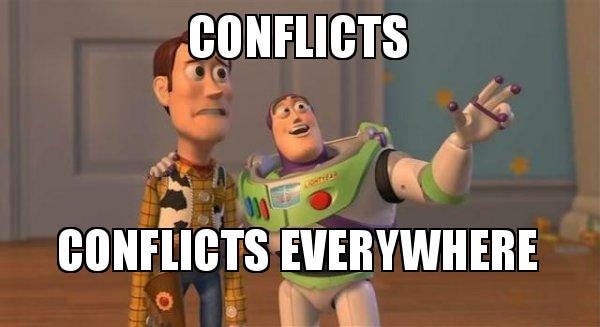
When conflict creates innovations
You remember that video when Steve Jobs brought the iPhone on stage? You can feel how the air just disappears in the hall when Jobs shows his new invention:
But do you know that this comes from the conflict?
In 2005, Apple had two competing projects trying to build a phone. Two teams. Two completely different approaches. And they did not agree.
One team wanted to shrink the Mac. Take the full computer experience and make it pocket-sized. Something that Microsoft was doing with its Windows CE. The other team wanted to expand the iPod. Add phone capabilities to something Apple already knew how to build.
Both teams were convinced they were right. Resources were limited. Only one approach could win.
And then there was the input debate. Stylus or fingers? The stylus camp argued for precision. The multi-touch camp argued for simplicity. Steve Jobs famously hated styluses, but the technical challenges of multi-touch were massive.
The tension was real. Teams competing. Engineers arguing.
And from this conflict? The iPhone. Not a small Mac. Not a phone-enabled iPod. Something entirely new that neither team originally envisioned. Multi-touch won, but the software architecture borrowed from both approaches.
Then-CEO Steve Jobs was notoriously opposed to stylus input—during the iPhone launch, he joked, "Who wants a stylus? You have to get 'em, put 'em away. You lose them. Yuck."
If everyone had agreed on day one, we might have gotten a Motorola ROKR with an Apple logo. Instead, the friction produced something that changed the world.
Now let’s talk about your team
You’re not building the next iPhone. But you are managing smart, creative people.
And smart, creative people have opinions. Strong ones.
They’ve spent years building expertise. They have experiences that shaped how they think. They have egos - yes, even the quiet ones. Everyone has their own ego, and you never know when they are planning to show it :)
Put a few of them in a room to solve a hard problem, and guess what? They will disagree. This is not a bug. This is a feature.
If your team never has conflicts, something is wrong. Either people don’t care enough to fight for their ideas, or they don’t feel safe enough to disagree. Both are bad.
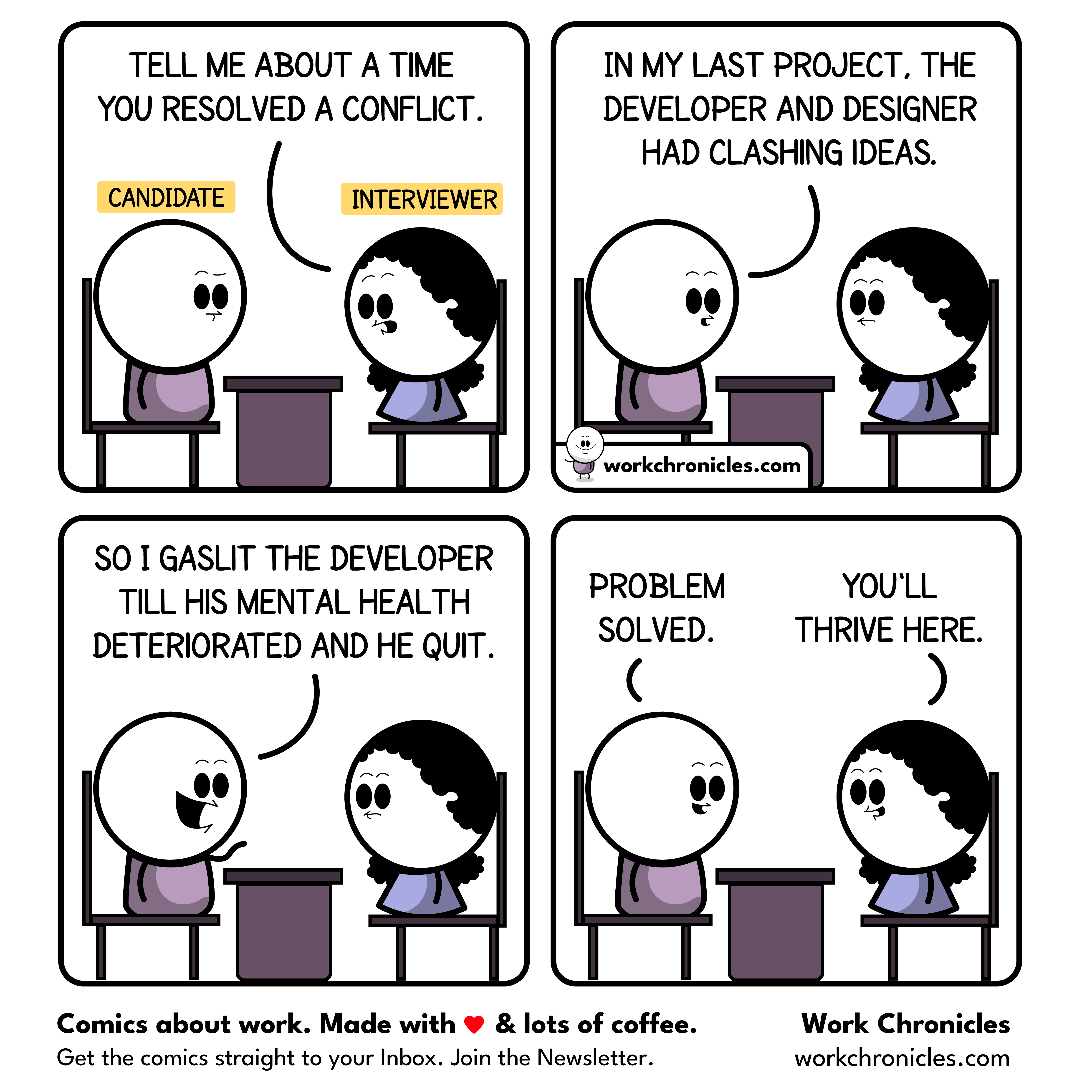
Where conflicts come from
Conflicts in teams rarely come from a single source.
Sometimes it’s ego. Two senior people who both want to be right. Neither wants to back down because it would feel like a loss.
Sometimes it’s knowledge. One person has context, the other doesn’t. They’re solving different problems without realizing it.
Sometimes it’s past experience. “I tried this before, and it failed” versus “I tried this before, and it worked.” Same approach, different outcomes, different conclusions. Fred Brooks would call it Second System Syndrome in his book “Mythical Man Month“ :)
And sometimes it’s just personality. Some people clash. Their communication styles don’t match. One is direct, the other reads it as aggressive. One needs time to think, the other wants decisions now. You probably had this one guy whom you don’t like, and you don’t even know why.
The reasons are endless.
But for you as a manager, the reason is secondary. The primary thing is solving it.
What solving actually means
This is what I am always telling young managers.
Solving conflict is not about finding who’s right and who’s wrong. Like a judge in a courtroom. Hearing both sides, making a ruling, case closed. But that’s not solving. That’s declaring a winner and a loser.
And losers remember.
Real conflict resolution is different. It’s not about proving someone right. It’s about finding a solution that both sides can live with.
Sometimes that’s a middle ground. A bit of this, a bit of that.
Sometimes that’s something entirely new. Like the iPhone. An option that didn’t exist until the conflict forced people to think harder.
Sometimes that’s agreeing to try one approach first and revisit if it doesn’t work. Lower the stakes. Make the decision reversible.
The goal is not justice or feeding someone's ego. The goal is moving forward together. Without making enemies.
A workflow for when conflict hits
So it happened. Two amazing people are in conflict. All of them have their own reasons. And both of them are right!
Step one: Separate the people from the problem.
Get them in a room. Or get them on a call with you. Start by acknowledging that you see a disagreement, and that’s okay. Make it clear this is not a trial. Nobody is in trouble. You’re here to find a path forward.
Step two: Let each side talk. Fully.
One person explains their position. The other listens without interrupting. Then switch. No discussing and not arguing yet. Just listening.
You’d be surprised how often conflicts exist because people never actually hear each other. They were too busy preparing their counterargument.
Step three: Find the shared goal.
Ask them: what are we actually trying to achieve here? Usually, both sides want the same outcome. They just disagree on how to get there.
When you surface the shared goal, the conflict shrinks. It goes from “I’m right, and you’re wrong” to “we both want X, we just see different paths.”
Step four: Explore options together.
Not “pick one of your two ideas.” Explore. Are there other ways? Can we combine approaches? Can we test one and have a fallback?
This is where the magic happens. When people stop defending their position and start solving together. But yeah, this is happening because we’ve separated people from the problem before. And now looking for a solution, not for the smartest in the room.
Step five: Make a decision and own it.
At some point, you need to move forward. If they can’t agree, you decide. That’s your job.
But frame it right. “We’re going with approach A. Not because B was wrong, but because we need to pick something. If A doesn’t work, we’ll revisit.”
Disagree and Commit. Sounds awful, works like a charm.
The manager’s role
Your job is not to avoid conflicts. Your job is to make conflicts productive. Conflict already appeared. Take as much as you can from it. Whether it is a learning or a team-building exercise.
That means creating an environment where people feel safe to disagree. Fighting for your idea doesn’t mean fighting against your colleague.
It means intervening early. Small disagreements are easy to solve. Long-time insults will be bitch to solve.
It means not taking sides too quickly. The moment you pick a favorite, you’ve lost half the room.
And it means modeling good conflict behavior yourself. Disagreeing respectfully. Changing your mind when presented with better arguments. Admitting when you were wrong.
Your team watches how you handle conflict. And they will mirror it.

Surprising fact
Conflict-free teams are not healthy teams. They’re teams where people have given up.
The best teams I’ve worked with argued a lot. They challenged each other’s ideas. They pushed back. They got frustrated sometimes.
And they built amazing things. Because the ideas that survived all that friction were actually good.
From what I’ve learned, conflicts are not the enemy. Unresolved conflicts are.
When you solve them well, you don’t just fix a disagreement. You build trust. You show your team that it’s safe to have strong opinions. And sometimes, you discover solutions that nobody would have found alone.
The goal is not to eliminate conflict. The goal is to make it useful.